If you want to improve your track day experience, bolting on more power is only half the story. The real gains come from understanding what the car and driver are doing on circuit, lap after lap. That is where modern data logging and in-car telemetry become serious tools rather than just cool gadgets.
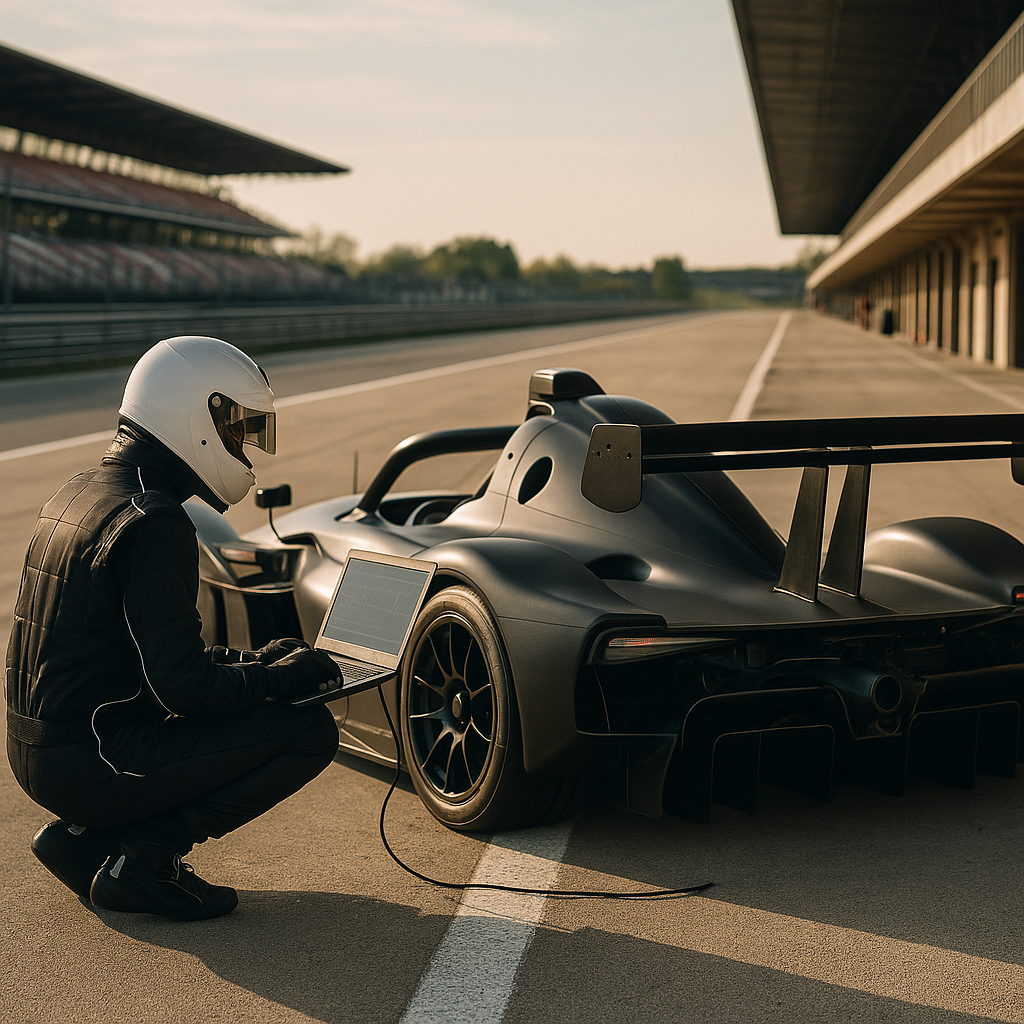
Why data logging transforms your track days
On a typical open pit lane day, most drivers judge performance by lap time, how the car feels and maybe a bit of tyre temperature checking in the paddock. That is useful, but it leaves a lot of performance hidden. Proper logging lets you break each lap down into braking zones, corner phases and straights so you can improve your track day experience with objective information rather than guesswork.
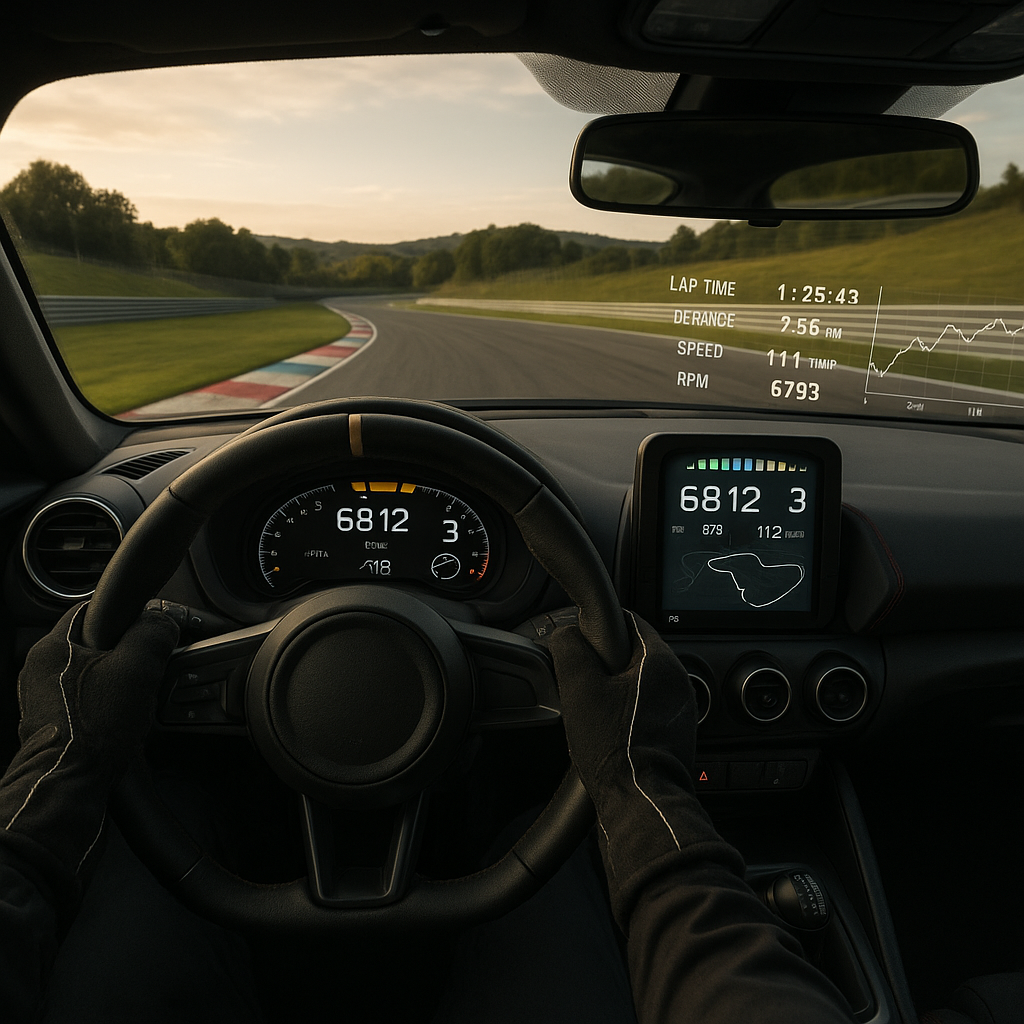
At a minimum, a decent logger will capture speed, GPS position and lap timing. Add channels like throttle position, brake pressure, steering angle and lateral/longitudinal G and you suddenly have a complete picture of what is happening. Professional outfits such as GSM have been using this sort of data-driven approach for years to help drivers find time without throwing endless money at hardware.
Choosing the right setup to improve your track day experience
The right hardware depends on your budget and how serious you are, but the fundamentals are the same.
Entry level: app plus OBD
For many road-based track cars, a smartphone app paired with an OBD dongle is a sensible starting point. You get GPS speed, basic engine parameters and simple lap timing. It is not millimetre-accurate, but it is enough to identify where you are lifting early, braking too long or missing apex consistency.
Mid range: dedicated lap timer and dash
Stepping up to a dedicated lap timer or dash logger gives better GPS resolution, more stable sampling rates and the option for extra sensors. This level is ideal if you are starting to chase tenths, run semi-slicks and want to monitor coolant, oil temp and brake performance properly to improve your track day experience safely.
Advanced: full motorsport logger
At the top end, a full motorsport logger with CAN integration, multiple analogue inputs and high frequency sampling lets you monitor almost anything: individual wheel speeds, damper travel, brake pressure at each corner, even tyre temperature via IR sensors. This is the territory where you can validate spring and damper changes, aero tweaks and geometry adjustments with hard data.
Key channels that actually make you faster
Collecting data is pointless unless you focus on the channels that drive lap time. For club-level track work, prioritise:
- Speed and GPS trace – lets you overlay laps and see exactly where you are quicker or slower.
- Throttle position – shows hesitation, early lifts and how smoothly you feed power in on corner exit.
- Brake pressure or decel G – highlights long, soft braking versus short, hard braking and where you could brake later.
- Lateral G – a good indicator of how much grip you are actually using compared with what the tyres should be capable of.
Even a simple comparison between your best and an average lap will reveal obvious opportunities to improve your track day experience without touching the spanners.
Using data to fine tune the car
Once you are comfortable reading the basics, you can start using logs to guide setup changes. For example, if you see very spiky lateral G traces combined with lots of steering correction on corner entry, the front end may be too stiff or too aggressive on turn-in. Conversely, long flat sections in the G trace can indicate under-driving or a conservative line.
Brake temperature and speed traces will tell you whether your pads and fluid are coping or if you are fading late in the session. That sort of insight is invaluable when deciding whether to invest in bigger discs, better cooling or a different compound to improve your track day experience while staying reliable.

Improve your track day experience FAQs
Do I need expensive equipment to improve my track day experience with data?
You do not need a full race-spec logger to improve your track day experience. A reliable smartphone app with good GPS and a basic OBD dongle is enough to start learning where you are losing time. As you progress, you can upgrade to a dedicated lap timer or dash logger that offers higher sampling rates and extra sensor inputs, but the key is using whatever data you have consistently rather than chasing hardware for its own sake.
How should I analyse my laps to improve my track day experience?
Focus on comparing a representative best lap with an average lap. Look for sections where your speed trace is clearly lower, or where you brake earlier and for longer. Check throttle position to spot hesitation on corner exit, and use lateral G to see whether you are using the available grip. Work on one or two corners at a time, apply changes in the next session, then review again so you build pace methodically.
Can data logging help with car reliability as well as speed?
Yes, logging is just as valuable for reliability as it is for lap time. Monitoring coolant and oil temperatures, brake performance and even fuel pressure can alert you to developing issues before they become failures. Over several events, patterns in the data will highlight whether you need better cooling, different brake pads or changes to your service schedule, all of which contribute to a safer and more enjoyable track day experience.
Leave a Reply