Most drivers spend more time thinking about their next car than about what happens when it stops working on a dark stretch of the A9 at half ten on a Tuesday night. A proper car emergency kit UK drivers can rely on is not a collection of gimmicks from a motorway service area. It is a genuinely considered set of tools that could keep you safe, warm and mobile while you wait for help. This guide breaks it all down, what to carry, why it matters, and what the Highway Code actually says about it.
What Does the Highway Code Say About Emergency Equipment?
The Highway Code does not legally mandate a specific list of items for private motorists in the UK, but Rule 283 recommends carrying a first aid kit, a fire extinguisher and a warning device (such as a warning triangle). Beyond those, the guidance is implicit rather than prescriptive. Commercial vehicles have stricter requirements, but for a standard car driver, the onus is on personal judgement. That said, breaking down without even the basics is not just inconvenient, on a live motorway or fast A-road, it can be genuinely dangerous. You can cross-reference the Highway Code online via gov.uk for the full picture.
Warning Triangles: Still Relevant, Still Important
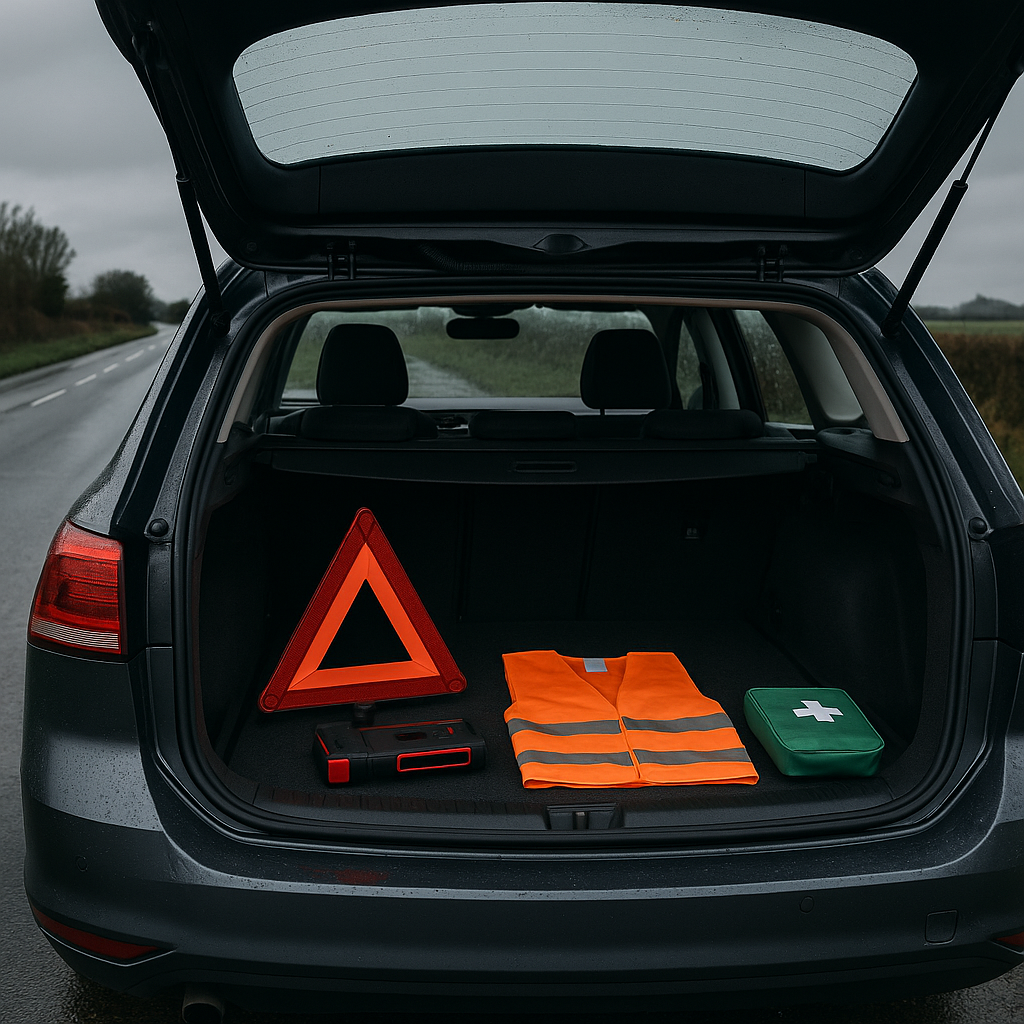
The warning triangle is one of the oldest pieces of kit going, and it remains genuinely useful. If you break down on a non-motorway road, placing a triangle roughly 45 metres behind your vehicle gives approaching drivers an early visual warning. The critical point: do not use them on motorways or smart motorways. On a live carriageway, you risk your life retrieving one, and the DVLA and National Highways both advise staying behind the barrier rather than standing in or near traffic lanes.
For motorway situations, high-visibility vests do far more practical work than a triangle. Keep one in an accessible spot, not buried under a spare wheel and a bag of shopping in the boot. RAC and AA data consistently shows that rear-end shunts are a major risk for broken-down drivers who exit their vehicles without proper visibility. A bright vest costs around £3 and takes up essentially no space.
Jump Packs: Leave the Jumper Cables at Home
Traditional jump leads require a second vehicle. That is fine on a busy retail car park, less ideal at 06:30 on a rural B-road in February. Lithium-ion jump starters have transformed this situation. A decent unit from brands like NOCO or Ring Automotive will start a 2.0-litre petrol engine reliably, fits in a shoe box, and doubles as a USB power bank for your mobile. The Ring RPPL300, for instance, is rated for engines up to 3.5 litres and weighs under a kilogram.
Charge it every three or four months and store it at around half capacity to preserve battery health. A jump pack is, genuinely, the single best addition to a car emergency kit UK setup. Flat batteries account for the largest share of breakdown call-outs, year after year, according to the AA’s annual breakdown statistics.
Foil Blankets, Warmth and Winter Conditions
Scotland, the Pennines, Dartmoor, the Welsh hills, the UK produces weather that can turn hostile fast. A foil emergency blanket weighs almost nothing and folds down to the size of a deck of playing cards. They reflect body heat back with genuine efficiency and are standard issue in most serious first aid situations. Keep two in the kit, not one. If you have a passenger, or if one gets damaged, you want the backup.
Alongside the foil blanket, consider a small fleece or a light waterproof jacket kept specifically in the boot. If you are stuck roadside for 45 minutes waiting for a recovery vehicle in January near, say, Shap Fell on the M6, you will not regret it.
Torches: Forget the Freebie from That Press Event
The drawer-clearing miniature torch with a CR2032 battery that goes flat every six months is not an emergency torch. A proper LED unit with at least 200 lumens, a decent beam distance and a solid grip is what you want. Head torches are particularly useful because they leave both hands free, which matters when you are checking a tyre or looking under the bonnet in the dark.
Olight and Ledlenser both make compact, robust options available from Halfords and Amazon UK. Keep spare batteries or pick a rechargeable model. Either way, test it every few months. There is nothing worse than reaching for a torch and finding the batteries have given up.
The Rest of the Kit: What Gets Overlooked
Beyond the headliners, a thorough car emergency kit UK should cover a few more bases:
- Tyre inflator or aerosol sealant, not a puncture fix for serious damage, but for a slow leak it buys you time to reach a garage. Many newer cars no longer carry a spare wheel, so this fills that gap.
- First aid kit, a compact certified kit from St John Ambulance or similar. BSI Kitemark kits are the standard to look for.
- Screenwash and a small de-icer, sounds obvious, but the number of drivers caught out by a frozen windscreen or an empty reservoir is remarkable every winter.
- Jump cables as a backup, even if you carry a jump pack, a set of cables weighs little and covers you for helping someone else.
- Water and a snack, if you are stuck for an extended period on a remote road, basic supplies matter. Not glamorous, but practical.
- Pen and paper, useful for noting incident details, registration plates, or leaving a note if you have to leave the vehicle.
Storing and Maintaining Your Emergency Kit
Assembly is half the job. Maintenance is the other. A boot kit that has been sitting untouched for three years is not reliable. Do a quick audit every six months, check battery levels on the jump pack, swap out any expired first aid consumables, confirm the torch works, top up water. Keep everything in a single, dedicated bag or box so nothing migrates around the boot and disappears under the seat.
Pre-built emergency kits are available from the AA, RAC, Halfords and Argos, ranging from around £20 to £60 depending on completeness. They are decent starting points, but the jump pack is usually sold separately, so factor that in. Building your own from individual items tends to give you better quality across the board for a similar budget.
Does the Time of Year Change What You Should Carry?
A core car emergency kit UK stays largely the same year-round, but autumn and winter justify additions. A snow shovel (compact folding versions are available), an ice scraper with a long handle, and additional warm layers all make sense from October through to March. If you are driving regularly on moorland roads or through areas the Met Office flags as prone to drifting, a small bag of sand or cat litter for traction under driven wheels is a professional-grade addition that costs almost nothing.
Summer brings its own risk, particularly overheating. Coolant top-up fluid and an extra bottle of water for the radiator overflow are worthwhile additions between May and September.
Frequently Asked Questions
Is a car emergency kit legally required in the UK?
There is no legal requirement for private motorists to carry a specific emergency kit in the UK. However, the Highway Code recommends a warning triangle, first aid kit and fire extinguisher, and carrying basic safety equipment is strongly advised by organisations like the AA and RAC.
What is the most important item in a car emergency kit for UK drivers?
A lithium-ion jump starter is arguably the single most useful item, given that flat batteries are the number one cause of breakdown call-outs. It works without a second vehicle and costs around £40 to £80 for a reliable unit.
Can I use a warning triangle on a UK motorway?
No. Using a warning triangle on a motorway or smart motorway is not recommended and is potentially dangerous. National Highways advises leaving your vehicle immediately if it is safe to do so, moving behind the barrier, and calling for help from a safe position.
How much does a complete car emergency kit cost in the UK?
A solid kit can be put together for between £60 and £100, covering a jump pack, foil blankets, torch, first aid kit, hi-vis vest, tyre inflator and basic tools. Pre-built kits from Halfords or the AA start from around £20 but often lack a jump starter.
How often should I check and update my car emergency kit?
A check every six months is sensible for most items. Pay particular attention to jump pack charge levels, first aid kit expiry dates, and torch batteries. Swap out seasonal items like de-icer or a snow shovel as conditions change.
Leave a Reply