Few things kill a morning faster than a flat battery in a supermarket car park at half seven in January. A compact lithium jump starter sitting in your glovebox changes that entire scenario. No waiting for breakdown recovery, no flagging down a stranger for jump leads, no embarrassment. Just clip, press, start, go. The problem is the market is absolutely flooded with these things now, and the spec sheets are routinely exaggerated to a degree that would make a dodgy used-car dealer blush.
This guide cuts through that. We’re looking at what actually matters when choosing a compact lithium jump starter for typical UK-market engines, how to read cold-cranking amp figures honestly, and which units are genuinely small enough to live in a glovebox rather than taking up half your boot.
What Cold-Cranking Amps Actually Mean for UK Cars
Cold-cranking amps (CCA) is the headline figure manufacturers plaster all over their packaging. It describes how much current the unit can deliver at -18°C for 30 seconds while maintaining a minimum voltage. The number sounds impressive until you realise that lithium pack manufacturers often quote peak amps rather than CCA, and the two figures are very different animals.
For context: most 1.0-litre to 1.6-litre petrol engines common in UK-market cars (think Ford Fiesta, Vauxhall Corsa, Volkswagen Polo) need roughly 200-400 CCA to start reliably in cold weather. A 2.0-litre diesel, such as the kind found in a Ford Focus Estate or Skoda Octavia, wants somewhere between 500 and 700 CCA. A larger 3.0-litre diesel or a V8 petrol is a different conversation entirely, and a compact jump starter is probably not the right tool.
When a pack claims 2000A peak, that peak figure is typically a burst lasting milliseconds. The honest working current for a sustained crank is significantly lower. Look instead for units that publish their CCA rating specifically, or at minimum their rated amps (not peak). Units from NOCO, Ring Automotive, and Halfords’ own range tend to be more transparent about this than cheaper imports.
Size vs Capacity: Does It Actually Fit in a Glovebox?
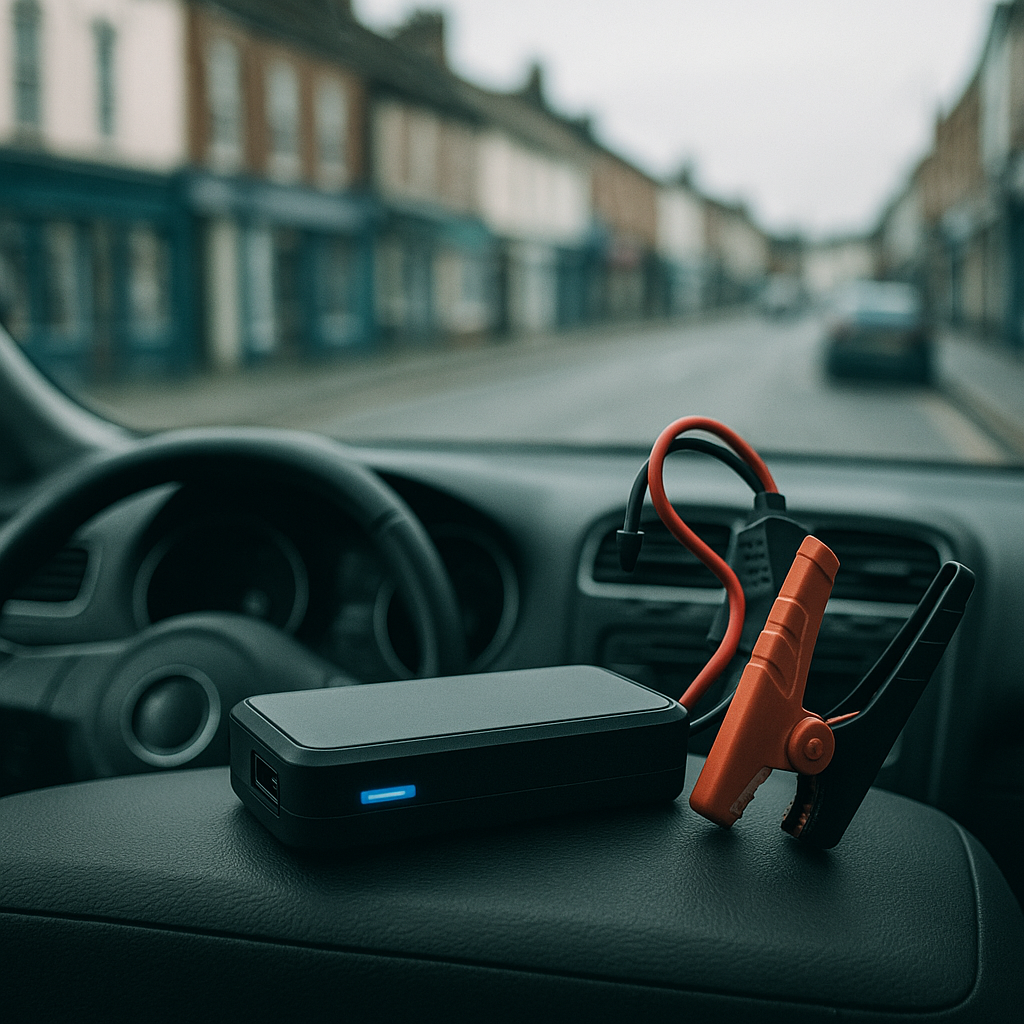
The whole point of a compact lithium jump starter is portability. If it lives permanently in your boot alongside a bag of emergency kit, that’s fine, but the genuinely useful units are the ones that disappear into a glovebox and get forgotten about until you need them.
A unit with a 12,000mAh cell, such as the NOCO Boost Plus GB40, measures roughly 18cm x 8cm x 4cm. That will fit in most glovebox compartments. Anything above 20,000mAh tends to push into power-bank-with-handles territory, which is still portable but realistically lives in a jacket pocket in your boot rather than a drawer in your dashboard.
Weight matters too. Lithium chemistry is far lighter than the old lead-acid booster packs, but cells still add up. Aim for under 500g if you want something genuinely pocketable. The Ring RPPL300, for example, tips the scales at around 320g and will handle a 3.0-litre petrol, which is impressive for something not much bigger than a thick paperback novel.
USB-C Charging and Multi-Function Features Worth Paying For
Modern compact power packs have evolved well beyond just jump starting. USB-C Power Delivery output is now common on mid-range and premium units, which means the same pack that starts your car can fast-charge a laptop, a mobile, or a tablet on the road. For anyone doing long motorway miles, that is genuinely useful.
Look specifically for USB-C PD at 18W or above. Some cheaper units include a USB-C port but only output at 5W, which is next to useless for modern devices. The NOCO Boost MAX GB150 goes further with 60W USB-C PD, but at that point you’re paying for a serious bit of kit and it’s no longer truly compact.
A built-in LED torch with an SOS flash mode is worth having. It sounds like a gimmick until you’re in an unlit layby on the A303 at 11pm trying to locate the battery terminals on an unfamiliar hire car. Most units include this now, but check the lumen output; anything under 100 lumens is barely better than your mobile’s screen.
Wireless charging pass-through is one feature you can largely ignore for this application. It adds cost and bulk without much practical benefit in a car environment. Spend the money on a higher CCA rating instead.
Safety Cut-Offs: Why This Spec Matters More Than Most Realise
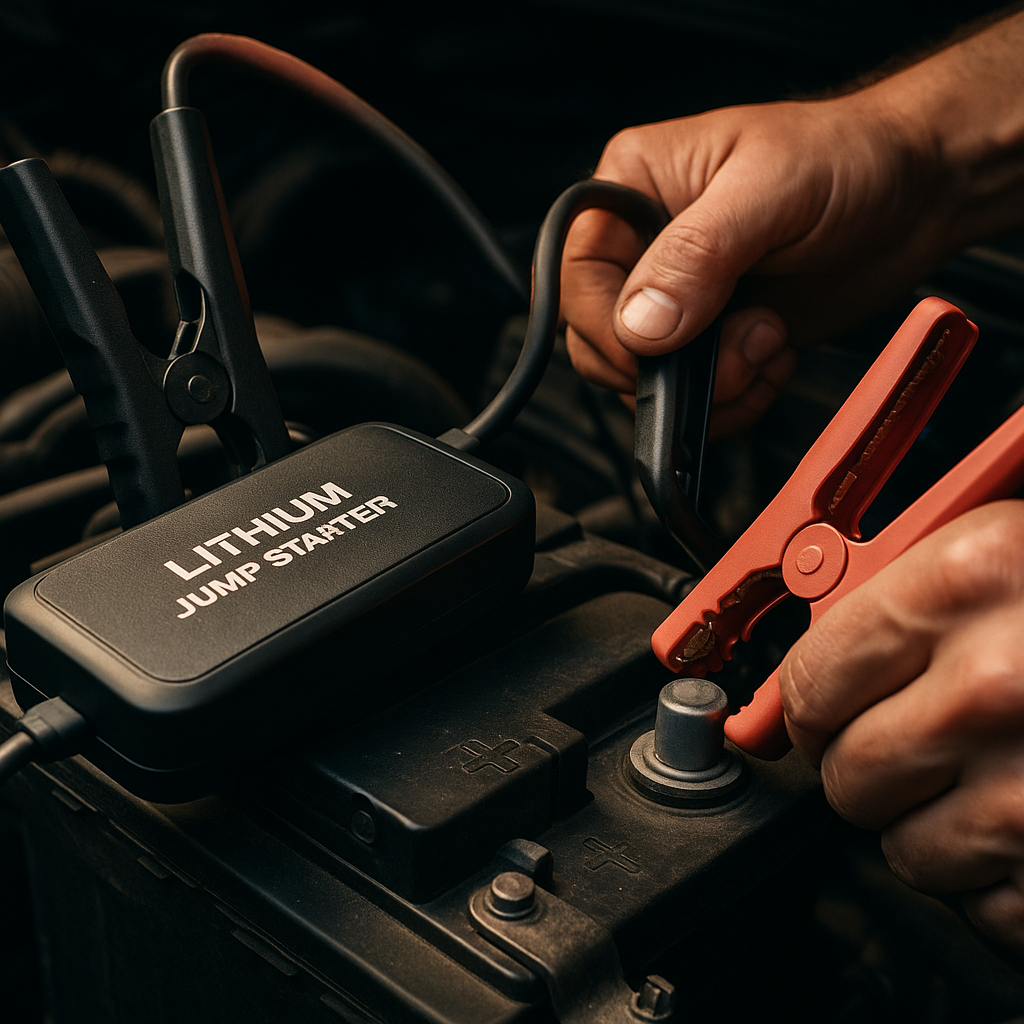
Lithium cells and high-amperage clamps connected to a car battery is a combination that demands robust protection circuitry. A quality compact lithium jump starter will include reverse polarity protection (it won’t fire if you connect the clamps incorrectly), over-voltage protection, short-circuit protection, and over-temperature cut-off.
This isn’t just about protecting your jump starter. A spark near a battery that has been venting hydrogen gas is a genuine risk. UK-made or European-CE-certified units go through testing that verifies these cut-offs actually work under load. The DVSA has published guidance on battery safety for fleet operators, and the same principles apply to anyone using booster equipment on a private vehicle.
Cheaper units from unverified suppliers often claim protection circuits but omit surge testing. If the price seems too good relative to the spec, that gap is usually being bridged by missing safety validation. Stick with Ring Automotive (a UK brand with a solid track record), NOCO, or Halfords-branded units for peace of mind.
It’s worth noting that precision engineering matters in any power-critical component, whether you’re maintaining a modern turbocharged hatchback or sourcing Massey furguson engine parts for agricultural machinery. Tolerances and reliability standards separate quality from junk in both worlds.
How to Maintain a Lithium Jump Starter So It’s Ready When You Need It
Lithium cells lose charge over time even when not in use. A unit sitting in your glovebox for six months without a top-up will likely be too flat to actually help you when a cold November morning defeats your battery. Most manufacturers recommend a charge cycle every three to six months. Charge it, check the LED indicator reads full, then put it back.
Temperature affects lithium performance significantly. If you leave a jump starter in your car during a hot British summer (yes, they do happen), prolonged exposure to temperatures above 40°C will degrade cell capacity faster than normal use. The same goes for deep winter storage; cells below -10°C perform poorly, though starting in -10°C British conditions is relatively rare outside of northern Scotland or the Pennines in January.
Store the unit partially charged if it’s going into long-term storage, ideally between 40% and 80%. Full charge accelerates cell ageing.
Which Units Are Actually Worth Buying in 2026
The NOCO Boost Plus GB40 remains one of the most recommended compact lithium jump starters for mainstream UK cars. It handles petrol engines up to 4 litres and diesel up to 3 litres, has proper safety circuitry, and includes a USB-A output alongside a decent LED torch. It’s widely stocked at Halfords and Screwfix, and the price has stabilised around £80-90. For the majority of Ford, Vauxhall, Volkswagen, and Toyota drivers in the UK, this is the default sensible choice.
The Ring RPPL300 is worth a look if absolute compactness is your priority. At 300A rated output, it won’t start a cold diesel van, but for urban petrol drivers it’s remarkably small and includes USB-C PD charging. Ring is a Birmingham-based brand with genuine UK distribution and warranty support, which counts for something.
For anyone running a larger diesel, the NOCO Boost Pro GB150 steps up to 3000A peak with genuine performance on heavy engines, though the form factor is more boot-bag than glovebox. Check the GOV.UK guidance on vehicle safety and equipment standards if you’re using booster equipment in a commercial vehicle context, as there are additional considerations for fleet use.
Whatever you choose, a compact lithium jump starter is one of those purchases you’ll forget about entirely until the morning it saves you two hours on a kerb waiting for a recovery truck. Get one, charge it up, and leave it in the glovebox where it belongs.
Frequently Asked Questions
What size compact lithium jump starter do I need for a diesel car?
Most 2.0-litre diesel engines common in UK-market cars need a unit rated at 500-700 CCA or a minimum 400A working current. The NOCO GB40 covers diesels up to 3 litres, while the GB150 handles larger commercial diesel engines. Always check the manufacturer’s engine size compatibility rather than relying on peak amp claims alone.
How long does a lithium jump starter hold its charge when stored in a car?
Most lithium units will retain a usable charge for three to six months when stored in a temperate environment. Extreme heat, such as a parked car in direct summer sun, accelerates discharge and degrades cell capacity. Top up the charge every three months as a routine, especially heading into winter when you’re most likely to need it.
Are compact lithium jump starters safe to use on modern cars with sensitive electronics?
Yes, provided the unit has proper over-voltage protection and reverse polarity cut-off, which quality units from Ring Automotive, NOCO, and similar brands include as standard. These protections prevent voltage spikes that could damage ECUs or sensor modules. Avoid very cheap unverified units that may lack certified protection circuitry.
Leave a Reply