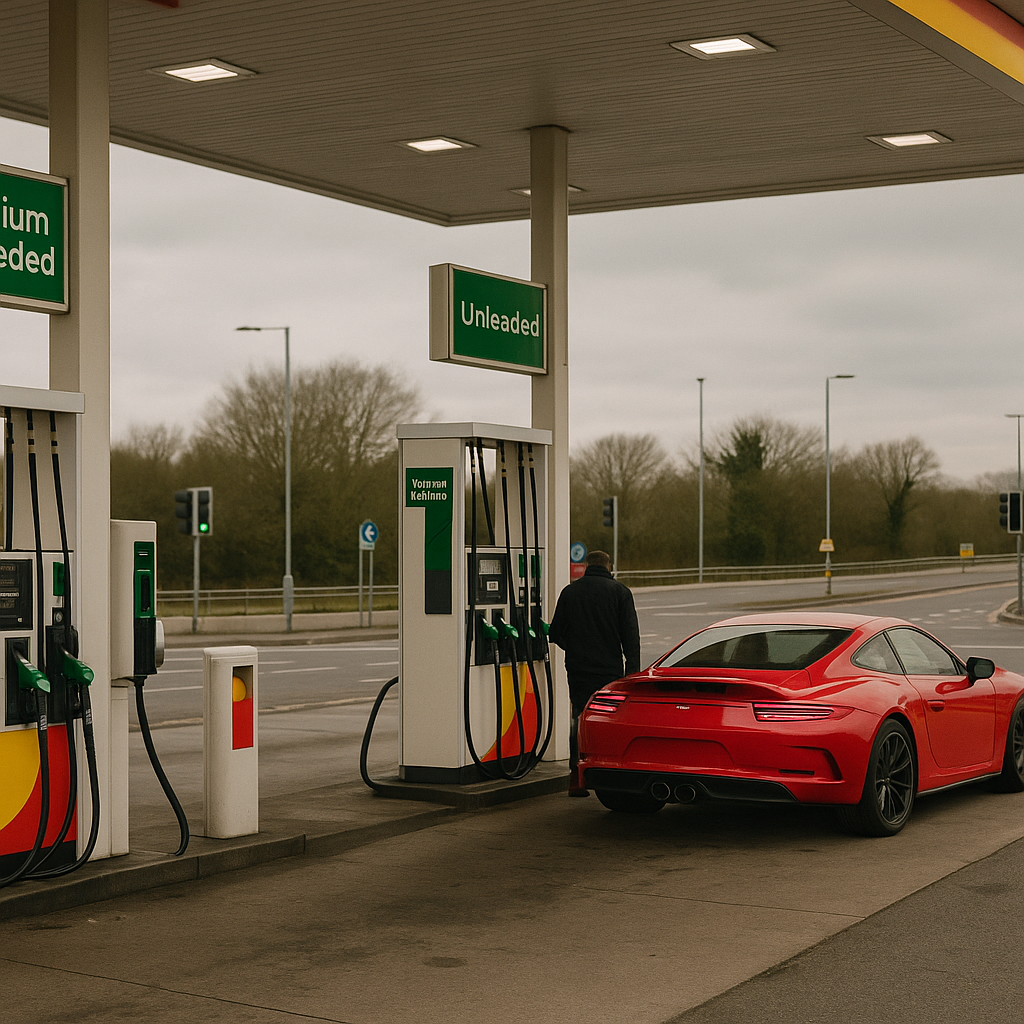
Pull up to any UK forecourt and you’re faced with at least three unleaded options. There’s the standard E10 pump, usually labelled 95 RON; the premium 97 or 99 RON option with a name like Shell V-Power or BP Ultimate; and sometimes a mid-grade in between. Most drivers grab whichever nozzle is cheapest and get on with their day. But if you’re running a performance car, a turbocharged engine, or simply care about what’s going in your tank, the differences matter far more than the price per litre suggests.
What Does RON Actually Mean?
RON stands for Research Octane Number. It’s a measure of a fuel’s resistance to pre-detonation, or what engineers call knock. When a petrol-air mixture ignites inside a cylinder before the spark plug fires, you get an uncontrolled pressure wave that hammers the piston at the wrong moment. That’s knock. It sounds like a faint metallic rattling under load, and over time it causes real mechanical damage.
A higher RON number doesn’t mean the fuel contains more energy per se. It means it’s more stable under compression and heat, so it resists that premature ignition. A 99 RON fuel won’t explode with more force than 95 RON; it just burns in a more controlled, predictable way. The practical upside comes in how modern ECUs exploit that stability.
95 RON Standard and the E10 Switch
Standard unleaded in the UK is now E10. It was introduced across Great Britain’s forecourts in September 2021, replacing the old E5 standard as the default 95 RON option. E10 contains up to 10% bioethanol, compared to 5% in the older E5 blend. Ethanol has a lower energy density than pure petrol, which is why some drivers report marginally lower fuel economy on E10, typically 1-3% worse in real-world testing depending on the engine.
The government’s gov.uk guidance on E10 petrol confirms that around 600,000 vehicles are not compatible with E10, mostly older cars from the 1990s and early 2000s. If your car is on that incompatibility list, E5 protection grade fuel (usually 97-99 RON premium) is your only standard unleaded option at the pump. Check the official compatibility checker if you’re running anything pre-2002 and you’re unsure.
Premium Fuel: What 97-99 RON Actually Does to Your Engine
Modern turbocharged engines are designed around knock management. The ECU permanently monitors combustion via knock sensors, and when it detects pre-detonation it retards ignition timing to protect the engine. Retarded timing means the spark fires later, the combustion cycle loses efficiency, and you lose power. Run a turbocharged car on 95 RON in warm conditions under hard acceleration, and the ECU will almost certainly be pulling timing.
Feed it 99 RON and the ECU can advance timing towards its optimum map, extract more torque from each combustion event, and often run higher boost pressure than the conservative base map allows. On engines with adaptive ignition maps, this isn’t theoretical. It’s measurable.
Real-World Power Gains: What to Realistically Expect
Published dyno data from independent tests on cars like the BMW 335i, Ford Focus ST, and Volkswagen Golf GTI typically shows a 3-7% increase in peak power when switching from 95 to 99 RON, provided the ECU is actively recalibrating. Some manufacturers, including Ford with the 2.3-litre EcoBoost, openly publish higher power figures in their technical documentation when running on 98-99 RON fuel.
Naturally aspirated engines with static ignition maps show less dramatic results. A classic Honda Civic with a non-variable timing map will see marginal gains at best. But a forced-induction engine, or any car that has been remapped to take advantage of higher octane fuel, is a different story. Remapping specialists across the UK routinely offer separate 95 RON and 99 RON tunes precisely because the fuel grade has a significant effect on how aggressively the map can be written.
Direct injection engines are particularly sensitive. High compression ratios, which are common on modern efficient petrols, generate more heat in the combustion chamber and are therefore more prone to knock on lower-grade fuel. Cars like the Audi TFSI family and the Volvo T5 engine genuinely perform better and more consistently on premium fuel.
Does Premium Unleaded Improve Fuel Economy?
This is where it gets nuanced. If your ECU is actively advancing timing on premium fuel, you extract more energy from each combustion cycle. In theory, this can offset some of the cost premium, particularly on motorway runs where the engine spends sustained periods under moderate load. Some drivers report a 2-4 MPG improvement on long motorway trips with premium fuel in turbocharged cars.
That said, premium unleaded in the UK typically costs 8-15 pence per litre more than standard E10 at time of writing. On a 60-litre fill, that’s an extra £5-£9. You’d need a genuine and consistent MPG improvement to justify the spend purely on economy grounds. For most urban driving in a naturally aspirated family car, the honest answer is no, the maths don’t work in your favour.
Which Cars Genuinely Benefit from Premium Unleaded?
There’s a clear split here. High-compression turbocharged engines benefit most. If your car’s handbook specifies 98 RON as recommended rather than just required, the manufacturer is telling you the engine is calibrated to take advantage of it. That covers a wide range of hot hatches, performance saloons, and sports cars.
Cars running aggressive aftermarket or OEM+ tunes absolutely benefit, and many remaps require 99 RON as a minimum to work safely at their stated power levels. Running a remapped engine on E10 95 RON isn’t just missing performance; in some cases it can trigger persistent knock retard that stresses the long-term mechanical health of the engine.
For a standard 1.0-litre three-cylinder city car or an older naturally aspirated engine with a conservative ignition map, premium unleaded is unlikely to produce any noticeable difference. The ECU simply can’t use the additional stability headroom the fuel provides.
A Practical Guide to Choosing the Right Pump
Check your owner’s manual first. If it says 95 RON minimum and your engine is naturally aspirated, standard E10 is fine for normal driving. If it says 98 RON recommended, premium is the correct choice and you’re likely leaving performance on the table otherwise. Turbocharged engines running even a mild tune are best served by 97 RON minimum, with 99 RON the sensible choice for track days or spirited driving.
E10 compatibility is non-negotiable for older vehicles. If your car isn’t on the approved list, protection grade E5 (which is the premium 97-99 RON product at most major forecourts) is your only safe option regardless of power considerations.
The question of whether premium unleaded is worth it in the UK doesn’t have a single answer. For a modified or high-compression turbocharged car used enthusiastically, it absolutely is. For a standard runaround doing school runs and supermarket trips, probably not. Know your engine, check your tune, and buy accordingly.
Leave a Reply