The Lake District is one of the most genuinely spectacular places you can point a car in England. Tight stone walls, sweeping valley views, passes that would embarrass most Alpine circuits and roads that demand your full attention. If you’ve ever fancied stringing together a proper driving tour rather than sitting in a caravan queue behind a tractor, this is how you do it properly.
These Lake District driving routes for enthusiasts aren’t your Sunday afternoon meander. We’re talking ascents with 30% gradient signs, blind hairpins, passing places where you genuinely debate who reverses first and summit views that make the effort completely worth it. Let’s get into the specifics.
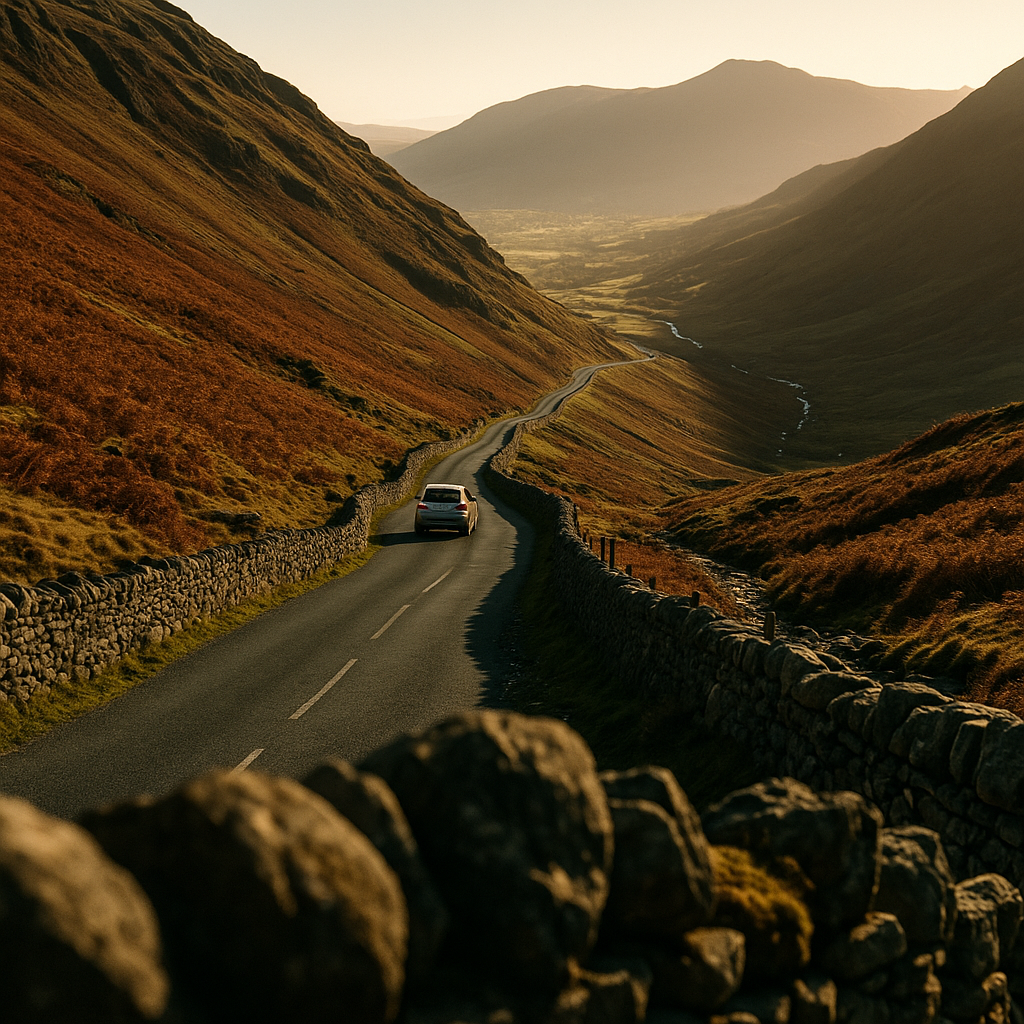
The Three Passes Every Driving Enthusiast Needs to Know
Hardknott Pass: England’s Most Demanding Road
Hardknott is, without question, the sharpest thing England puts on public tarmac. The western approach from Eskdale is where it really bites: gradient signs read 1-in-3 (that’s 33%), the hairpin bends are tight enough to require a three-point turn in longer vehicles and the surface can be greasy even in summer. The eastern descent into Cockley Beck is marginally more forgiving, but only marginally.
From a mechanical standpoint, respect the climb. Use a lower gear on the way up and engine brake on the way down. Manual gearboxes are your friend here. If you’re driving an automatic with a heavier vehicle, be conscious of brake fade on the descent. Clutch smell on the ascent is common. If you start to smell burning, pull into a passing place and let things cool. This isn’t a motorway. There’s no recovery lane.
The summit also sits adjacent to a Roman fort, Mediobogdum, which is worth five minutes of your time. Park at the flattened area near the top and walk the short distance. It’s an extraordinary spot.
Wrynose Pass: Hardknott’s Quieter Neighbour
Wrynose sits immediately east of Hardknott, and the two are usually driven in sequence as a natural pairing. Many drivers underestimate Wrynose because it comes after Hardknott’s drama, but it has its own challenges. The road surface here can be rougher in places, the stone walls are close and the passing places demand the same spatial awareness.
What Wrynose does offer is slightly better rhythm. Once you’ve picked your line and got used to the pace, it flows more than it stutters. The Three Shire Stone at the top, marking the old county boundaries of Cumberland, Westmorland and Lancashire, is a worthwhile photo stop. The views across Little Langdale are exceptional on a clear morning.
Kirkstone Pass: Accessible Drama on the A592
Kirkstone is the most accessible of the three, running on the A592 between Windermere and Ullswater via Patterdale. It’s a proper A-road in designation but very much a mountain pass in character. The Inn at the Top, the Kirkstone Pass Inn, sits at 454 metres and is reputedly one of England’s highest pubs. Worth a stop.
The northern descent into Ullswater is the one to savour. Long, open and with stunning views across the valley, it lets you settle into a proper driving rhythm. This is also one of the better roads in the Lakes for early morning runs when traffic is minimal and the light across the fells is extraordinary.
Timing Your Visit: How to Avoid the Peak-Season Gridlock
The Lake District welcomes somewhere in the region of 19 million visitors per year, according to the Lake District National Park Authority. A significant proportion of those arrive between late July and the end of August, and on bank holidays throughout the year. Kirkstone Pass becomes a car park. Hardknott and Wrynose, despite being far more technically demanding, still attract queues of unprepared vehicles.
The smart play is early. Very early. On summer days, aim to be at the foot of Hardknott by 07:30 at the latest. You’ll be over both passes and parked in Langdale before the guided tour minibuses even load their passengers. Late September and October are arguably the best months overall: the bracken turns rust and gold, the crowds thin considerably and the air is clear. May and early June are another strong window before school holidays.
Weekdays always beat weekends, obviously. If your schedule allows a Tuesday or Wednesday visit, the difference is remarkable.
Narrow Road Etiquette: What Every Driver Needs to Understand
Single-track roads are governed by basic convention, not complex rules. The driver going uphill generally has priority because reversing downhill on a steep gradient is genuinely dangerous. When you encounter an oncoming vehicle on a pass, make eye contact early, identify the nearest passing place and one of you reverses to it. Whoever is closer to the passing place usually reverses. It’s not a negotiation; it’s practical common sense.
Do not stop your vehicle across a passing place. Do not park in them. They exist for moving traffic, not picnics. On Hardknott especially, holding up vehicles behind you on an ascent because you’ve stalled or need to cool your brakes is common. If this happens to you, use your hazard lights and wait. Other drivers who know the pass will understand and wait calmly. Don’t panic-reverse on a 1-in-3 gradient.
Horns are acceptable on blind bends where you genuinely cannot see oncoming traffic. One short blast as you approach a blind hairpin on Hardknott’s western ascent is courteous and sensible, not aggressive.
Where to Park: The Honest Guide
Parking in the Lake District is one of the more contentious parts of any visit. The National Trust operates a number of pay-and-display car parks across the area, and these are consistently the safest and most practical choice. Facilities at Langdale (Stickle Ghyll), Great Langdale and near Wastwater are managed and reasonably priced.
Roadside verge parking on the narrow passes should be avoided entirely. Not just because it’s inconsiderate, but because it creates genuine hazards for vehicles that need to use passing places. Cumbria Constabulary and national park rangers do issue penalties on popular routes during peak periods.
For the Eskdale approach to Hardknott, park at Boot village or the Woolpack Inn car park (check opening times and any charges). For Wrynose, the layby near Fell Foot Farm in Little Langdale is a reasonable option early in the morning before it fills up.
What Car Works Best on These Routes?
Any reasonably maintained car can complete Hardknott and Wrynose, but there are sensible caveats. Low-profile tyres on aggressive wheel fitments are going to suffer on the rough tarmac sections. Long-wheelbase vehicles struggle on the tighter hairpins, and some won’t complete Hardknott’s switchbacks without reversing. Vans and motorhomes are not recommended and are actively discouraged on Hardknott during summer.
The ideal tool is something with decent ground clearance, strong low-end torque and a manual gearbox. A well-sorted hot hatch, a light SUV or even a classic with fresh brakes and a healthy clutch will be perfectly at home. Make sure your tyre pressures are correct before you set off. Under-inflated tyres on a sustained mountain descent are a genuine safety concern.
These Lake District driving routes for enthusiasts reward preparation. Check your coolant, check your brake fluid and, if you’re running a vehicle with any existing issues, sort them out before you drive into a valley with no mobile signal and a 33% gradient beneath you.
Suggested Route for a Full Day’s Drive
Start at Ambleside by 07:30. Head south briefly before cutting west through Skelwith Bridge and into Little Langdale. Ascend Wrynose from the east, stop at the Three Shire Stone, then drop into Cockley Beck and climb Hardknott immediately westward. Descend into Eskdale, have breakfast at the Woolpack Inn when it opens, then loop north via Ravenglass and the coastal road before heading back inland through Wasdale. Return to Ambleside via the Kirkstone Pass descent from Ullswater. You’ll cover some of the finest Lake District driving routes for enthusiasts in England in a single day, and be back before the gridlock peaks on the A591.
Frequently Asked Questions
Is Hardknott Pass suitable for all cars?
Most standard cars can manage Hardknott Pass as long as they’re in good mechanical condition with a healthy clutch and brakes. Low vehicles with very little ground clearance, long-wheelbase vans and motorhomes are not recommended. Always check that your brakes and tyres are in good order before attempting the 1-in-3 gradients.
What is the best time of year to drive the Lake District passes?
Late September through October and May to early June offer the best combination of good road conditions, thinner crowds and excellent light for driving. Summer school holidays from late July through August bring significant congestion, particularly on Kirkstone Pass and the approaches to Langdale. Early morning starts on any day make a major difference.
Are Hardknott and Wrynose passes open all year?
Both passes are generally open year-round but can be closed by Cumbria County Council during severe snow, ice or storm events in winter. There are no automatic barriers; closures are managed as conditions dictate. Always check local road conditions via the Cumbria traffic updates before setting off between November and March.
What should I do if I meet oncoming traffic on a single-track pass?
The driver closest to the nearest passing place should reverse to it. Vehicles ascending steep gradients generally have priority over those descending as reversing downhill is more hazardous. Stay calm, make eye contact with the other driver early and use gentle hand signals if needed. Never park across passing places.
Where can I park near Hardknott Pass?
The most practical options are Boot village in Eskdale on the western side or the small layby at Cockley Beck on the eastern approach. National Trust pay-and-display car parks in Langdale are good starting points if you plan to walk as well as drive. Avoid parking on road verges or in passing places, as this creates hazards and can attract penalties from national park rangers.
Leave a Reply