The gap between your seats is prime real estate, and most drivers waste it completely. Loose change rattling around, a phone sliding off the passenger seat, a charging cable going AWOL somewhere under the handbrake, sound familiar? A decent between-seat or centre console organiser fixes all of that for under £40 in most cases, and the difference it makes on a daily commute or a long motorway run is genuinely noticeable. This guide cuts through the noise and looks at what actually works for right-hand-drive cars on UK roads.
Why RHD compatibility matters more than people think
Most of the organiser market is designed with left-hand-drive layouts in mind. American brands in particular position USB ports, cup holders and phone slots on the side that, in a UK car, ends up facing your passenger rather than you. It sounds like a minor gripe until you’re reaching across an armrest to plug your phone in whilst doing 70mph on the M6.
When you’re shopping for the best car centre console organiser UK drivers can actually use, look for models that are symmetrically designed, or ones specifically marketed as RHD-friendly. The strap-and-buckle systems that slot between the seat and centre console need to fit snugly against a UK handbrake position, which is typically more central than on continental cars. Width matters too, UK-spec versions of popular models like the VW Golf, Ford Focus and Toyota Corolla have slightly different transmission tunnel widths to their left-hand-drive equivalents, so always check the listed dimensions.
Between-seat gap fillers vs full console trays
There are two main categories here and they serve different purposes.
Gap fillers, such as the Lusso Gear Car Seat Gap Filler (around £18 a pair), are rigid foam or plastic strips that simply block the void between the seat and centre console. They stop things falling down there, full stop. No storage, no functionality, just a neat solution to a very specific problem. These work brilliantly in cars where the gap is genuinely narrow and you mostly want to stop coins and cards disappearing.
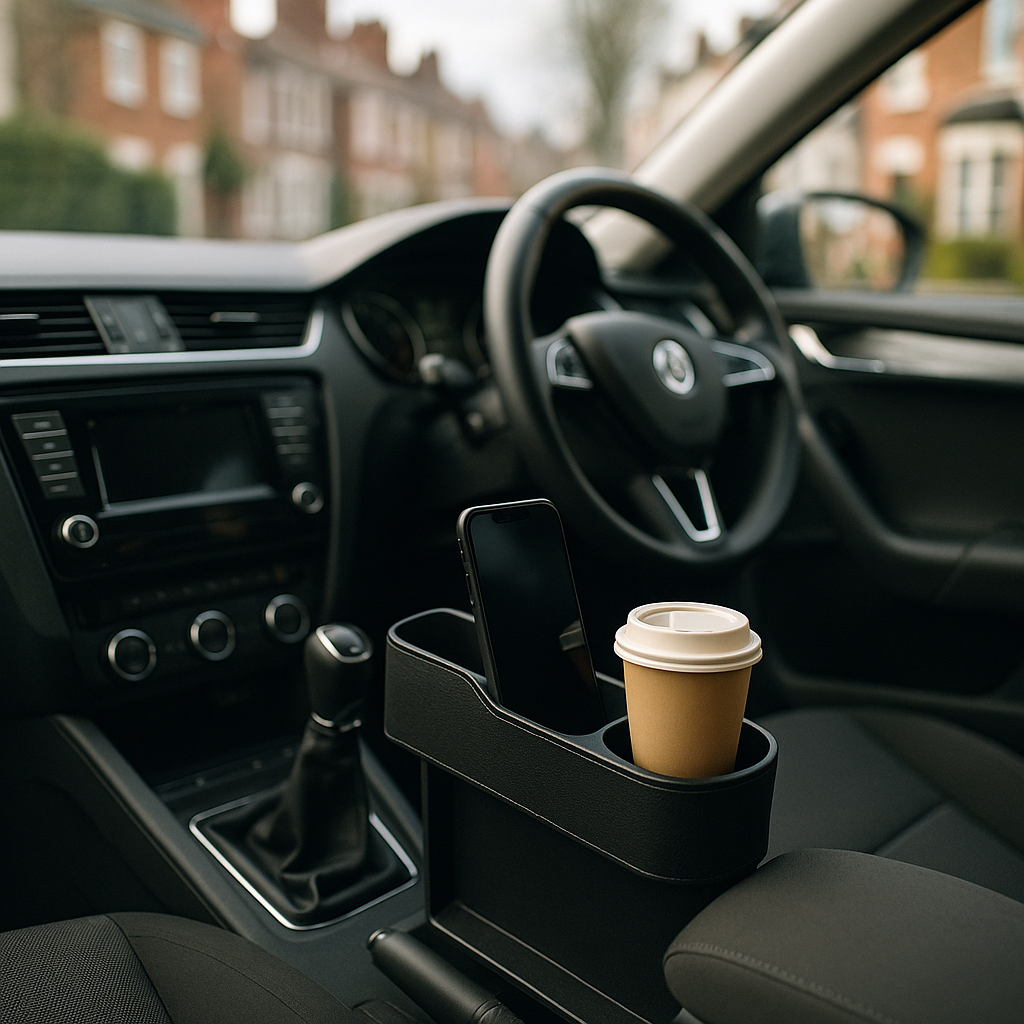
Multifunction console organisers are more substantial. They sit in the gap or mount directly onto the existing console and add cup holders, USB charging hubs, phone slots, coin trays and sometimes a small lidded compartment for valuables. Brands like ITrims, Ecomade and the ever-popular EasyAcc console boxes occupy this space. Expect to pay between £20 and £60 depending on build quality and features.
USB access and charging integration
This is where budget products fall apart. A console organiser with a built-in USB hub sounds great on paper, but cheap versions have two problems: they often run off a single 5W output (nowhere near fast enough for a modern smartphone), and the cable management is a complete mess if you’ve got a USB-C lead for your phone plus a cable for your passenger.
If USB charging is a priority, look for organisers that either have a pass-through design (letting you route your existing USB cables tidily without a built-in charger), or ones that pair with a proper car charger puck sitting in the 12V socket. The latter gives you far more control over charging speeds, particularly relevant if you’re using a wireless car charger for the driver’s phone mount, because you’re already using one 12V socket and need to think about load.
The Mpow and Nulaxy branded organisers both handle cable routing well and have received consistently solid reviews from UK drivers on Amazon UK. The Mpow unit (around £26) has an adjustable base strap that fits most RHD gaps without modification, and the USB routing channel keeps cables out of the cup holder zone.
Build quality and what actually holds up day to day
Leatherette versus ABS plastic is the big divide. Leatherette-wrapped organisers look premium in photos and feel nice for the first few weeks, but the stitching tends to peel if you’re regularly tossing keys and coins into them. Hard ABS plastic with a matte or rubberised finish handles the daily abuse of commuting far better. Look for a base tray that’s deep enough to hold a standard 500ml water bottle without it tipping, because that’s usually the make-or-break use case for most drivers.
Lid mechanisms matter too. Some organisers have a flip-top lid on a small storage compartment, fine for parking tickets or a pair of glasses, but cheap hinges crack after a winter of opening and closing in cold temperatures. British winters are hard on plastics, particularly in cars that sit outside overnight. A simple snap-close lid is more reliable than a spring-loaded one in this context.
The RAC and various UK consumer groups have noted that interior storage is one of the most requested after-market improvements among UK drivers. You can read more about equipping your car sensibly for everyday use and longer trips in our guide to what to keep in your boot for emergencies, worth reading alongside this if you’re doing a broader car organisation overhaul.
Best picks for commuters vs long-distance drivers
For commuters doing short daily runs, think urban or suburban driving, lots of stop-start, regular parking, the priority is quick-access slots for a phone, an Oyster card or contactless card, and somewhere for a takeaway coffee cup that isn’t the standard flimsy OEM cup holder. A compact gap filler with a dual cup holder extension is the sweet spot. Keep it simple.
Long-distance drivers doing regular motorway miles need more. A lidded storage section for toll receipts and service station tickets, a secure phone slot that keeps the device visible without blocking the gear lever, and enough room for a proper reusable water bottle or a flask. If you’re regularly doing stints on routes like the M1, M4 or M6, you’ll appreciate having snacks and essentials within arm’s reach rather than in the boot. For those motorway regulars, our honest review of the best UK motorway service stations pairs well with this kind of setup thinking.
Fitting, compatibility and what to measure before you buy
Before ordering anything, grab a tape measure and check three dimensions: the gap width between your seat cushion and the centre console, the height from the seat to the top of the console, and the length of the section you want to fill. Most organisers list a gap range of roughly 5cm to 12cm, but UK cars do vary, and a Ford Kuga’s gap is meaningfully different to a Skoda Octavia’s.
Velcro-strap systems are generally more adjustable than hard-clip systems, and they don’t leave marks on the seat fabric when you remove them. That matters if your car is on a PCP agreement or company lease and you need to return it in original condition. According to the BBC, PCP and lease finance now accounts for a significant share of all new car registrations in the UK, so this is a real consideration for a lot of drivers.
If you’ve already invested in decent seat support, and if long drives are your thing, you might want to look at seat cushions and lumbar supports for motorway driving, a good console organiser rounds out the driving environment considerably. It’s the kind of upgrade that costs very little but makes the interior feel properly sorted rather than an afterthought.
Spend a bit of time measuring, read the compatibility notes carefully, and pick something with a hard base and adjustable strap. You’ll wonder how you managed without it.
Frequently Asked Questions
What is the best car centre console organiser for UK right-hand-drive cars?
Look for symmetrically designed units or those explicitly listed as RHD-compatible. The Mpow and Nulaxy console organisers are popular among UK drivers because their strap systems adjust to fit the narrower gaps in common UK models like the Ford Focus and VW Golf. Always check the gap width dimensions before purchasing.
How do I measure the gap between my car seat and centre console?
Use a tape measure to check the width of the gap (typically 5 to 12cm in most UK cars), the height from the seat cushion surface to the top of the console, and the length you want to fill. These three measurements will tell you which organiser will actually fit without wobbling or being too tight to remove.
How much does a decent in-car console organiser cost in the UK?
Basic gap fillers start from around £15 to £20 for a pair. Multifunction organisers with cup holders, phone slots and USB cable routing run from about £20 to £60. You don’t need to spend at the top of that range, mid-tier options around £25 to £35 tend to offer the best balance of build quality and practicality.
Will a console organiser damage my car seats or interior?
Most use velcro straps or foam padding rather than hard clips, so they won’t scratch or mark seat fabric. If your car is on a PCP or lease agreement, a strap-based organiser is the safest option as it leaves no trace when removed. Avoid units with metal clips that could scuff leather or alcantara trim.
Leave a Reply